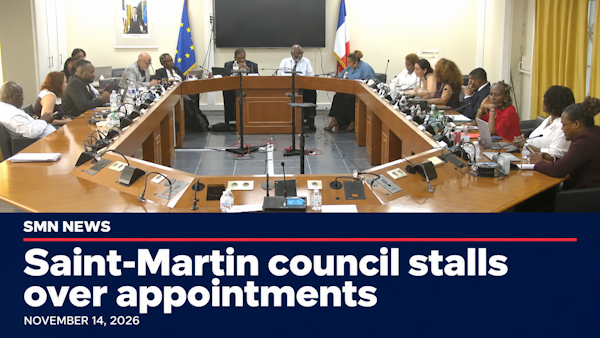
MARIGOT, Saint-Martin:--- President Louis Mussington refused to put new appointments to a vote Saturday morning as Saint-Martin’s Territorial Council resumed after Friday’s suspension. Councilors pressing for changes to committees and outside bodies, including the Tourism Office, argued that Friday’s Executive Council reshuffle gave the assembly grounds to act immediately. Mussington said the appointments were outside the published agenda and offered to meet Monday morning to discuss when they could be taken up. The council paused again after members of the new majority asked for time to decide their next move.


Saturday’s roll call recorded 16 councilors present and seven excused, with several absentees represented by proxy. Mussington acknowledged arriving an hour late and repeated his apology after councilors raised the delay during the debate.

The two sides differed over what Friday’s vote allowed the council to do next. Councilors seeking the appointments cited Article LO 6321-25 of France’s General Code of Territorial Collectivities. It says the Territorial Council may form its committees and designate representatives to outside bodies after the Executive Council is elected. They argued that Friday’s changes gave the Territorial Council the authority to vote on those appointments on the spot.

Mussington said the changes arose from a replacement within the current term and argued that the council could only take up items on its agenda. He also said he preferred to wait for the administrative legality review of Friday’s resolution before formally treating the Executive Council’s composition as changed. He offered to form a joint committee to seek agreement on how to proceed and gave no date for a vote.

Councilors challenge the delay

Councilor Philippe Philidor rejected the offer of further talks, saying the council was asking Mussington to apply the organic law. Senator and Territorial Councilor Daniel Gibbs said the group pressing for a vote had 12 councilors present or represented by proxy. He also questioned whether Friday’s sitting had originally been adjourned and subsequently treated as a suspension, a distinction he said would affect the notice required to convene another meeting.

Councilor Raphaël Sanchez challenged the argument that the appointments were outside the agenda. He said the draft resolutions and supporting papers were sent on October 23 and presented at the October 29 Executive Council meeting, where he said Mussington and members of the executive declined to examine them.

Mussington acknowledged that six councilors could submit matters for consideration. He maintained that the president decides when they come before the assembly and said the proposals would be added to the agenda later. Councilors pressing for action argued that the Territorial Council should decide by majority vote whether to proceed.

Nicolas-Rembotte says councilors acted to gain access to records

Mélissa Nicolas-Rembotte apologized to residents watching the exchanges and to Collectivité staff called in on a Saturday. She said Friday’s reshuffle stemmed from years of requests for information. Councilors had sought Executive Council agendas and asked for a review of delegations they considered unlawful, she said, adding that they had never received the agendas. She said the new majority gave them a chance to exercise their right to information.

Nicolas-Rembotte said the appointments themselves could take place later if the assembly decided to defer them. She argued that Mussington should first ask councilors to vote on whether to proceed with reconstituting the boards. She also objected to his description of Friday’s proceedings as a “charade,” pointing to five suspensions on Friday and the hour councilors waited Saturday.

Philidor recounts how four proposals reached the floor

Philidor said councilors first requested that four draft resolutions be placed on the agenda under the organic law. When that failed, he said, they invoked Article 14 of the council’s internal rules and submitted a motion containing the four proposals. He said Mussington declined to put the motion to a vote.

According to Philidor, the agenda item to fill one Executive Council vacancy gave the assembly a route to elect all six members who serve alongside Mussington. The new majority used that vote to choose three new vice presidents, he said. He then asked Mussington directly whether he would put a resolution on committee and board appointments to a vote.

Mussington defended his handling of the agenda and said councilors were presenting substantive resolutions through a motion. He cited a Saint-Barthélemy case that he said upheld the territorial president’s decision to leave a vacancy off the agenda. He said he had chosen to list the Saint-Martin vacancy and argued that any resolution debated and adopted outside the agenda could be struck down if challenged in administrative court. Councilors countered that the appointments flowed from the Executive Council vote already taken and again asked him to let the assembly decide.

Mussington proposes Monday talks before council pauses again

Mussington said he was willing to meet councilors Monday morning, November 16, to agree on when the proposals could go before the Executive Council and then the Territorial Council. He said the law set no deadline for naming committee members or representatives to outside bodies. Councilors pressing for a decision said the word “may” in the statute gave the assembly the choice, and that a vote could settle whether it wanted to proceed.

Councilor Michel Petit backed Mussington’s position on the agenda. He recalled that the appointments at the start of the current term went ahead under an agenda signed by then-President Daniel Gibbs that expressly listed them. Petit argued that a resolution adopted outside the agenda could be annulled if challenged.

Members of the new majority then requested a suspension to discuss how to proceed with the sitting and what to do next about the Collectivité’s governance. Mussington granted the recess and told them to take the time they needed. He set no time for the sitting to resume.

Tourism Office representation at stake

The standoff follows a split that left Mussington’s camp with 11 seats in the 23-member Territorial Council. On Friday, the 12 councilors on the other side opposed his proposed agenda changes. The Saturday dispute tested whether that majority could move from defeating the president’s proposals to voting on its own appointments.

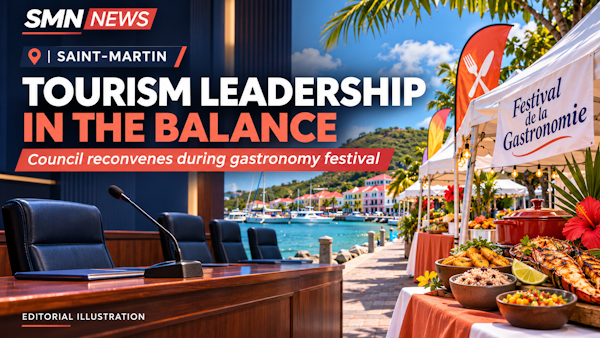
One proposal seeks to renew the Collectivité’s representation at the Saint-Martin Tourism Office, putting its presidency under Valérie Damaseau in the spotlight while the Festival de la Gastronomie is underway in Marigot. 

Saint-Martin’s Territorial Council will resume its sitting on Monday, Nov. 16, after failing to reach a quorum when members returned from Saturday’s recess. The lack of a quorum prevented the council from continuing, leaving the proposed appointments to committees and outside bodies, including the Tourism Office, unresolved.

HARBOUR VIEW, PHILIPSBURG:---  On Friday, November 13, 2026, His Excellency Governor Ajamu G. Baly administered the oath to Mrs. Johanna E.W.M. Verschueren-Sommers, a new member of the Council of Advice. The Council of Advice recommended appointing Mrs. Verschueren-Sommers because of her educational and community-oriented profile. National Decree of October 6, 2026, appointed Mrs. Verschueren-Sommers. The swearing-in ratifies the appointment. Mrs. Verschueren-Sommers has more than 40 years of experience in education, community development, and project management. She is committed to educational innovation and community impact. Governor Baly congratulated the new member in her role as legislative advisor and emphasized her added value at the Council of Advice.

MARIGOT, Saint-Martin: --- Saint-Martin’s Territorial Council will reconvene at 11 a.m. Saturday, with opposition and independent councilors pressing to replace Valérie Damaseau as president of the Tourism Office. The push comes as the sixth Festival de la Gastronomie, a signature initiative of her tenure, holds its second day of events on the Marigot waterfront.

Friday’s session was suspended after councilors elected six members of the Executive Council serving alongside President Louis Mussington. In an interview with Le Pélican, Senator Daniel Gibbs said Mussington asked to resume Saturday after feeling unwell. Gibbs said his group would return to committee and external appointments, arguing that the executive reshuffle gave the council grounds to revisit who represents the Collectivité.

The Tourism Office presidency is one of four issues opposition and independent councilors had sought to put on Friday’s agenda. The others concern the Collectivité’s representation at SEMSAMAR, powers delegated to the Executive Council and the Beauperthuy land matter. Gibbs said the proposals had been submitted in advance and that a request to add them during Friday’s meeting was refused. No vote removing Damaseau had been confirmed ahead of Saturday’s session.

From Gibbs’s first vice president to Senate rival

Damaseau became First Vice President of the Collectivité when Team Gibbs took office in 2017. She later broke with Gibbs and led her own Alternative slate in the 2022 territorial elections. After the first round, Alternative joined Louis Mussington’s list. This September, Damaseau faced her former political ally in the Senate election and lost to Gibbs 13–11 in the second round.

The Senate race also exposed a split within Damaseau’s former slate. Bernadette Venthou-Dumaine, who ran with Alternative in 2022, entered the Senate race herself and announced her departure from Mussington’s RSMA group. She is now among the councilors outside that group. That history makes the effort to remove Damaseau look like political payback. Whether a private dispute over Senate backing influenced the push to replace her remains unverified.

A signature tourism project is underway

Damaseau has helped shape tourism promotion on the French side for much of the past decade. The Festival de la Gastronomie, launched in 2021 during her tenure, has grown into a 12-day program that puts local chefs, restaurants and Saint-Martin’s culinary traditions in front of residents and visitors. This year’s festival runs through November 22. Saturday’s program includes the Gastronomy Village and a cooking workshop on the Marigot waterfront.

The proposed change concerns Damaseau’s role as president of the Tourism Office. Aïda Weinum directs the office and opened this year’s festivities in Grand Case. With the festival underway, councilors seeking to replace Damaseau face a question that goes beyond who has the votes. What would a leadership change deliver for Saint-Martin’s tourism sector, and why should it happen now?

U.S. departures resumed Friday night after an air traffic control communications failure. Airlines faced thousands of cancellations heading into the weekend.

PHILADELPHIA: The Federal Aviation Administration lifted its nationwide ground stop Friday night, November 13, but disruptions carried into Saturday. By early Saturday morning, flight-tracking service FlightAware listed more than 3,200 cancellations for flights within, into or out of the United States. 

U.S. Transportation Secretary Sean Duffy said the FAA lifted the order at 8:15 p.m. Eastern time Friday, or 9:15 p.m. in Sint Maarten. He warned that departures would resume gradually as airlines worked to position aircraft and crews. Reuters reported that nearly 10,000 flights had been canceled by 11:30 p.m. Friday, citing Flightradar24. 

Communications failure prompted the nationwide stop

The FAA issued the order Friday afternoon after communications problems affected multiple regional air traffic control centers. Duffy said officials detected inconsistencies in radar data and communications with aircraft while more than 3,500 planes were in the air. He said older communications equipment had overloaded, and officials were still investigating what triggered the failure.

Homeland Security Secretary Markwayne Mullin said investigators had found no evidence of a cyberattack as of Friday evening. Federal officials said they found no connection between the FAA failure and the separately reported Microsoft outage.

What the disruption means for Sint Maarten travelers

Saturday’s cancellation count covers the United States and international flights to and from the country. A breakdown of cancellations at Princess Juliana International Airport was unavailable at the time of publication. Travelers flying between Sint Maarten and the United States can check their flight status directly with their airline before leaving for the airport. 

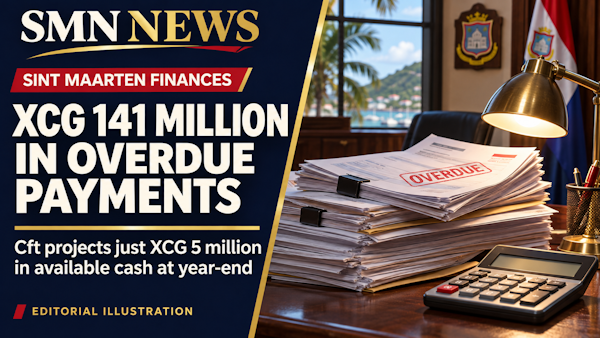
The financial supervisor projects just XCG 5 million in freely available operating cash at year-end and wants a project-by-project accounting of government investments.

PHILIPSBURG:--- Sint Maarten recorded a preliminary operating surplus of XCG 46 million through June 2026, but ended the same period with XCG 141 million in overdue payments. The Board of Financial Supervision for Curaçao and Sint Maarten (Cft) is urging the government to improve its cash position and reduce those arrears, with freely available operating cash projected at just XCG 5 million by year-end.

In a November 11 letter to Finance Minister Marinka Gumbs, Cft Chair Hans Hoogervorst said that level of liquidity leaves the government little room to absorb unexpected setbacks and meet payment obligations on time. The board provisionally found that Sint Maarten met the central budget standard and the legal requirement to compensate for past deficits. It qualified that finding because parts of the budget fall short of statutory reporting standards. An audited annual account is needed to determine compliance with certainty.

Second-quarter report arrived more than ten weeks late

The Cft received the second-quarter financial report on October 28. The statutory deadline was August 11. The 2026 budget had not been adopted in the first half of the year, and the report compared actual 2026 revenue and spending against the 2025 budget. The Cft also compared against the adopted 2026 budget.

The board said the delays limited the government’s ability to adjust in a timely way. It asked Finance to use the 2026 budget as the benchmark in its third-quarter report, explain significant differences and substantiate its full-year outlook. The government forecasts an operating surplus of XCG 11 million for 2026, compared with XCG 10 million in the adopted budget. The Cft said the report gave no detailed basis for that forecast.

Revenue reached XCG 323 million through June, or 50 percent of the annual budget. Operating expenses totaled XCG 277 million, or 43 percent. Both were about XCG 11 million higher than in the same period last year. Personnel costs rose by XCG 9 million to XCG 122 million as the government filled vacancies and incurred higher salary, overtime and civil-service healthcare costs. Overtime remained above budget.

Reported tax revenue rose from XCG 246 million to XCG 290 million. The Cft said reclassification explained much of the increase. During the first half of 2026, an estimated XCG 25 million previously recorded under other revenue was assigned to the appropriate tax categories. Permit revenue fell from XCG 6 million to XCG 3 million, with the government citing delays in billing and collection.

Only XCG 4 million in government investments recorded through June

The Cft’s capital-account table showed XCG 12 million in first-half spending against a full-year capital budget of XCG 187 million. Of the amount spent, XCG 6 million went to loan repayments, XCG 2 million to student loans and XCG 4 million to government investments.

The board said the government’s capital overview still relied on the 2025 budget and included a refinancing item from the previous year. It also noted that the 2025 year-end report already showed spending against some government investment reserves and against the Mental Health Foundation reserve. The Cft wants an updated accounting for each project and related loan, showing the budgeted amount, actual spending, commitments, remaining schedule and reasons for any delays.

The finding adds context to the November 9 budget debate, when Gumbs told Parliament that XCG 42.1 million in planned 2026 borrowing had shifted to 2027. MPs Sarah Wescot-Williams and Darryl York pressed for details on which projects would be ready to start once funding became available and when the government could realistically submit its 2027 loan request.

SZV, GEBE, TelEm and postal service risks remain unresolved

The board said the financial risks facing the Social and Health Insurance agency (SZV) and government-owned companies remain insufficiently documented. It wants the government to quantify the potential impact on the national budget and identify what it is doing to contain those risks.

For GEBE, the most recent audited accounts available to the Cft were for 2024. They showed a profit of XCG 2 million, down from XCG 18 million in 2023. Receivables and other claims rose to XCG 11 million, with uncertainty about how much it can collect.

TelEm struggled to meet obligations to lenders and requested a government guarantee of XCG 5 million. The government reported that it had yet to grant the request. The CFT said current financial information on Postal Services Sint Maarten was unavailable and described the company as having negative equity and relying on government support to continue operating.

The board also said it still lacks the information it needs to determine whether Sint Maarten exceeds its statutory interest burden limit. The government has yet to formally establish which entities fall within the collective sector for 2024 through 2027, and the Cft is still awaiting reports for 2021 through 2024. It has asked Finance to complete that work and provide the outstanding information.

More Articles …

Subcategories